Wednesday, February 23, 2011

The Two Montreals

Charter of Ville de Montréal

CHAPTER I
CONSTITUTION OF THE MUNICIPALITY
1. A city is hereby constituted under the name “Ville de Montréal”.
Montréal is a French-speaking city.

Montréal is the metropolis of Québec and one of its key actors as regards to economic development.

There it is, written for all to see, the declaration by the city itself that Montreal is French, a declaration which was untrue when it was written and which remains an outlandish lie today.

The uncomfortable reality for those who propagate this myth is that Montreal was conceived and built by the Scots and the English, with the Irish contributing most of the heavy lifting. Strolling down Ste. Catherine Street, it's no accident that almost all the cross streets honour those Anglos who built our metropolis.
Bishop, Crescent, Mountain, Drummond, Stanley, Peel, Metcalfe, Mansfield, McGill, University, Union, Phillips, Aylmer and City Councillors.
Fourteen streets in a row, representing the heart and soul of downtown Montreal and every one of them named for our historical Montreal Anglophone community. How come?

The great lie that Montreal is a French city rests on faulty statistics and decidedly wishful thinking, propagated by language fantasists living in unreality.

Pumped up artificially by coercive language laws meant to hide Montreal's true English face, separatists cannot stomach that the English language and its culture endures and thrives.
As these language militants they themselves admit (when they have the crying towel out), Montreal is made up by about 50% of its citizens whose mother tongue is French, with the balance split almost perfectly between English native speakers and ethnics speaking a variety of languages.
As for cultural assimilation, the 'ethnics' split their loyalty (much to the chagrin of French language militants) about 50/50 between the English community and the French community. The real language demographic has the city about ⅔ French and about ⅓ English.
This is the reality of modern Montreal.

But consider this;
Montreal is really two cities living side by side. There isn't a Berlin wall bisecting the two, but the division is as real as can be.

Running north/south is the boundary street of St Lawrence Boulevard, splitting the city rather neatly into two  halves. On the east side, you'd be hard pressed to find an anglophone. It's a part of the city that few tourists visit, because quite frankly, there isn't much to see or do over there. As I said, the population is almost completely francophone (except for the Italians in St. Leonard and Anjou.) Here francophones live with those ethnics who have assimilated into the francophone side of the language equation, the Arabs from the Mahgreb, the creole speaking Haitians and various French African immigrants, as well as a small peppering of South Americans who seem as a community to have chosen French.

Olympic Stadium-A mediocre symbol defining its neighbourhood
I won't spend time running down the east, suffice to say it is the denizen of the Mario Beaulieus and Louis  Prefontaines. It is the Plateau Mont-Royal and Amir Khadir. It's one recognizable symbol, the monstrous Olympic stadium, is a testament to hubris and incompetence and everything else that's bad about Montreal.

The western part of the Island is a completely different story. It's the Montreal that owns the downtown core, great universities and colleges, Mont Royal Park and quite frankly, anything of value that is Montreal.
It is as different from East Montreal as one can imagine.

Here the Anglos exist in numbers equal to the French speakers and it's where the ethnics are aligned with the English. The Indians, Tamils,  Pakistanis, the Jamaicans and others from the islands. From the downtown core out to the western tip of the island, its a whole other ballgame.
This is the Montreal that the world sees and understands, a cosmopolitan, bilingual and exciting urban scene that is by any standard, world class.

Our Montreal - the west
This Montreal is unaffected by dimwit language purists, it is a place of innovation and experimenters, both English French and ethnic. It is vibrant and exciting and most Canadians will admit that its the most exciting place in the country.

One Saturday night as the hockey game, at the then Molson Centre let out, the crowds surged out of the building onto the surrounding streets as per usual.
At the corner of Ste. Catherine and Metcalfe a left-turning cab cut me off as I was crossing the street and immediately got snared in a jam. As the cab sat in the middle of the intersection, the back window rolled down to reveal two fans bedecked in Maple Leafs jerseys, obviously in town for the hockey game. The one sitting by the open window looked out and sheepishly apologized for the driver's rudeness.
It bowled me over.
"Wha??..." I retorted, "Listen, friend. This is Montreal. You don't apologize!"

This Montreal has its very own rules. Pedestrians jaywalk and cars run through red lights. Crosswalks exist, but like the batters box in major league baseball which are duly painted before each game, only to be erased by the umpires, don't count on anyone respecting them. Montreal must be the only place on Earth that has signs under the traffic lights, reminding drivers to wait for the 'green.'

There's an edginess to this Montreal that is hard to describe. This Montreal, contrary to what we are told, may be the most bilingual place on earth, where locals flick between French and English depending on whom they are addressing. It isn't only a place where people can speak two languages, it is a city that actually operates in two languages. Bar conversations are bilingual, even among friends. The intermarriage (or shacking up) rate is high.
No Anglo would ever use the word 'corner store' when 'depanner' is so much easier and it's where francophones describe those whom they dislike as 'loosers' (notice the anglicized and francized spellings of both words.)

If you want perfection, go to Toronto, a city described to me once, quite appropriately by a Montreal expat as the "Kraft Dinner City" (for its originality.)
Almost everything great in Canada originated in Montreal. No doubt Toronto can do it bigger and better and I'm sure that one day they'll have a BIXI system that will outstrip ours. By then we'll be on to something else. We are the innovators.
Before you detractors out there say it, I'll admit, we can't run a hospital decently and have a dysfunctional government to boot.
Montreal isn't easy.
Detractors will remind us about  potholes, riots, the disorganization and the tension.
But the Chinese have a saying- 'In danger there is opportunity'. In Montreal, we can say that "In chaos there is creativity."
Montreal endures as the greatest place in Canada for creativity and innovation and in two languages to boot. Hip and cutting edge.

This is the Montreal that is Arcade Fire.

When French language militants say the the music group isn't representative of Montreal, they are talking about the Montreal on the other side of St. Lawrence Boulevard. In that respect I agree with them.

But Arcade Fire is exactly what our Montreal is.

When language hardliners cross the border from the East into downtown, they are outraged. While forced artificially to adopt a French face because of Bill 101, the reality that English dominates becomes self-evident rather quickly. For French language hardliners its a hard pill to swallow.

The hotels, the restaurants, the hospitals, the schools, the bars, the stores, the airport.
English, English, English ......Too bad for French language fantasists...

Next time you hear a language militant complain that Arcade Fire doesn't represent the true face of Montreal, point them to the East, kick'em in the arse and tell them to get out of our Montreal...

Tuesday, February 22, 2011

Arcade Fire Dérange


déranger inconvenience, bother,  disquiet,  perturb,  trouble....
 - - - - - - - - - - - - - - - - - -
By now all of Canada is aware that Montreal's Arcade Fire won the  prestigious Grammy for album of the year for their album "The Suburbs." Following that victory they jetted off to London to accept two Brit awards.
The accolades are pouring from all quarters, even the City of Montreal put up a congratulatory banner on their website and Quebec's Parliament passed a special congratulatory motion.
How do you say 'bandwagon' in French?

The reality is that to Quebec's narrow-minded music industry and the French language militants that run the show, Arcade Fire's win is nothing to celebrate, the group and its newly won Grammy is actually a huge embarrassment.

To these narrow-minded anglophobes, Arcade Fire represents the Quebec's music industry worst nightmare, a wildly successful artistic group, singing in English and claiming Quebec as their artistic home.

For the entrenched music industry in Quebec, English music is considered a threat and a force to be countered, not encouraged.
For ADISQ, the powers that run the Quebec music scene, it is official policy to discourage English music in Quebec and so that is why, while Arcade Fire is eligible for Grammy awards in the USA, the Brit awards in England and the Junos in Canada, they are not eligible at home, for the major categories in the Quebec music industry's awards because they don't sing in French.

The 'Felixs', Quebec's music awards, restrict nominations in major categories to French singing artists and so Quebec's hottest artists such as Arcade Fire, Bobby Bazini, Sam Roberts, or Ian Kelly cannot participate. It's no wonder that the Felixs are about as prestigious as bowling club trophies.

And so even francophone artists that sing in English are treated as lepers by the Quebec music industry, which believes that by shunning English singing artists they will somehow influence and control the musical tastes of Quebeckers.
"ADISQ behaves like a cult with its parish feast which denies the reality of Montreal. It's small and dusty , "tweeted radio host Paul Arcand.
Strangely, nowhere on ADISQ's French only website is the policy of promoting French language music to the detriment of English language music explained. Perhaps it is wise of them not to enunciate a racist policy that denies Quebec's English singing artists equality.
"Since 1978, ADISQ is working for the  survival  and blossoming of the production of  independent music, strong, original and innovative."
(Depuis 1978, l’ADISQ travaille à la survie et à l’épanouissement, au Québec, d’une production musicale indépendante, forte, originale et innovatrice.) LINK
This banner appears on the bottom of the ADISQ website, so its a bit disconcerting to see that English Canada is paying in large part for an organization that discriminates against English-singing artists.

In spite of their efforts, Arcade Fire is proof of the failure of this bankrupt mentality that is reminiscent of totalitarian regimes which try to restrict access to the Internet or who attempt to control what citizens read and see on television.

If you think Arcade Fire's win will change this optic, you're sadly mistaken.
"Organizers of Montreal's Fete Nationale celebration say the band would have to sing their songs in French, like any other act playing at the festival for Quebec's annual holiday
The chief organizer said Wednesday that the Grammy-winning band would be welcome to play the June 24 event if it wanted to. "As long as they conform to certain guidelines," When asked whether those guidelines included not singing in English, and performing in French instead," Savard replied: "Voila." LINK
Given their lack of success in controlling what Quebeckers listen to, perhaps in conjunction with the OQLF,  ADISQ will ramp up the pressure and ban English music altogether. Maybe we will see a new cadre of hybrid music/language inspectors raiding the bedrooms of francophone tweens, ripping Justin Bieber posters off the wall.

What ADISQ and French language militants refuse to admit, is the hidden reality that the Montreal English music scene, unsubsidized and unrecognized by the Quebec music industry is setting North America on it's ear.  Montreal's hip underground music scene based in the Mile End district of Montreal, Canada's most creative neighbourhood, is attracting attention from artists and industry insiders across North America.
"Though Montreal may not have the commercial punch of Nashville, its musical assets extend far beyond Arcade Fire. In a study of Montreal's creative economy I conducted with Stolarick and consultant Lou Musante in the early-2000s, we found musicians from around North America relocating there to take advantage of the city's historic and cultural heritage, openness, and affordable real estate.  Montreal is also home to Cirque de Soleil, a cultural force in its own right.
Upon accepting the award for best record, Win Butler, the leader of Arcade Fire--who hails originally from Texas--noted the bond between music and his adopted city.  "I just want to say thank you, merci, to Montreal, Quebec, for taking us and giving us a home and a place to be in a band." Talking with reporters after the show he added: "There's such a beautiful arts scene and music and dance (and) a lot of creative forces there." This is clearly a guy who thinks a lot about place: his band's award winning album is titled "The Suburbs." Read the story in THE ATLANTIC


This incredible Montreal music scene is not an anglophone-only invention. The fact that the artistic language is English, hasn't stopped francophone artists and fans from participating.
In fact, Arcade Fire's success lies not only in its Anglo supporters, but in large part to the Quebec francophone fan base which recognized and embraced their talent almost immediately.  Long before the world even heard of Arcade Fire, the group was gaining a following in the Quebec music scene, with no help of course, from ADISQ. From artsy coffee houses in the Mile End to suburban shopping centre performances in Longueuil, to the Quebec Summer Music Festival, Arcade Fire's rise can be credited to the group's talent and the support they earned from their Quebec fans, both English and French.
It's a wonderful testament to the musical sophistication of Quebec francophones who embraced an English-singing group before the world discovered them. No bandwagon here and no help from the powers that be, Quebeckers of all linguistic groups proved that it is they and they alone, who decide what music they listen to and moreover, that they have discerning taste.

Of course the French language militants are apoplectic. Louis Prefontaine compared this group to that of a Montreal ethnic restaurant, tasty and good, but not really an authentic Quebecois dish.
No doubt he prefers Poutine.
He rags on the one Francophone member of the group for pursuing a music degree at McGill University and choosing English to perform in. Link

Arcade Fire's success painfully underlines what Mr. Prefontaine wishes to deny, that is, if you want to make it internationally, you've got to perform in English.  Just ask Celine Dion (who actually removed the French accent in her name) and Guy Laliberté, Quebec's most successful entertainment exports.

One of the most telling observations was made in a comment by 'Rawkenroll,' under Mr. Prefontaine's rant;
"There are artists who are content to do the CEGEP and the festival tour, generously funded out of our taxes.

There are other artists who set their sights on the world and promote Quebec across the globe.

Some people praise Loco Locass. Some people shit on Arcade Fire.

These are the people who are overpaid to ring up sales at the SAQ.

Others are playing to audiences in Las Vegas and travelling into space.

You're right Louis, Arcade Fire is nothing like us.
....They are successful and ambitious."
 Touché! 

By the way, Saint Jean Baptiste organizers need not worry about Arcade Fire singing in English at the separatist holiday celebration, they'll likely be off on a world tour!


Read:

We Will Not Be Quiet!

Sunday, February 20, 2011

Heritage Classic Another Slap in the Face to Quebec

I might understand the lack of French at yesterday's 'Heritage Classic" hockey game in Calgary, should it have been treated as just another NHL game, one of just 82, but that wasn't the case.

The whole patriotic affair was wrapped up in our flag, packaged and sold as a national celebration of Canadian hockey, complete with a flyby by the Snowbirds, the Canadian air force's demonstration team.  The event was hyped as such by the CBC and Hockey Night in Canada, otherwise why else broadcast the game nationally on a Sunday night?

It was most definitely not just another hockey game!

It may just come down to a case of bad manners, or perhaps more sadly a case of mean-spiritedness, something westerners are not generally known for, but the exclusion of French at this national event was disgraceful, repugnant and downright shameful.

It made the Vancouver Olympics opening ceremonies look downright inclusive.

What can you say about a broadcast that sings the Star-Spangled Banner in front of two Canadian teams in Canada to satisfy the twelve American viewers watching on the American cable channel VERSUS and forgets to sing O Canada bilingually in respect of the more than the million viewers from Quebec who are tuning in.
All it would have taken was a few French words in the national anthem and a couple of bilingual banners.  Too much to ask, really?

If the Flames organization forgot, the Montreal Canadiens were their guests and were good sports to participate in an extraordinary affair that would largely pay dividends to the home team.

Yeeeechhh............!!!!!!!!1
The Montreal Canadiens didn't seem to matter all, it's as if the Habs were playing the Washington Generals to the Calgary Flames, who were incidentally, so handsomely bedecked in uniforms that made the dead and buried Canadiens barbershop outfit look positively dashing.
At least Montreal had an excuse for wearing the horrifically ugly barbershop uniforms- they were authentic.
What idiot in the Flames organization dreamed up a pretend vintage uniform that is even uglier?

No, not even Tim Horton's could muster a word in French in its many humungous advertising banners splashed all around the stadium.  Pas une maudit mot!....

At any rate the whole event was tedious.
The local musical talent was hard to stomach with the anthems sung rather dully and the 'half-time' show another descent in musical hell with a shrieking blond, part of indie rockers Metric who are certainly no Arcade Fire. . PAINFUL!!!!
 Perhaps they need to move to the Mile End to hone their talents! 

The game looked like a exhibition match with all the players afraid to hit or be hit, with good reason.
The horrible ice insured that the Canadiens faster game would be neutralized and that the locals would get their dream come true.

I hope the Canadiens will never allow themselves to be used this shallowly again.

The Calgary Flames organization disrespected them and all Montreal Canadiens fans in Quebec.

Next time, let the Calgary Flames play with the Edmonton Oilers in a hundred degrees below zero and see if the rest of the country actually gives a crap.

Calgary chose the Montreal Canadiens for the fan interest and the gravitas that Canada's most storied franchise brought to the event.

Shame on the Calgary Flames , for inviting the guest of honour guest to their party and treating the team as a prop.

Shame on the NHL for encouraging this total disrespect!

Friday, February 18, 2011

Hypocrisy Reigns in Religous Debate

A ruling by Quebec's Tribunal des droits de la personne ordered an end to the practice of Christian prayers before city council meetings in the city of Saguenay, as well as demanding that the city remove the crucifix hanging in the debates hall. The decision is sending shock waves throughout Quebec. The court concluded that the mayor and council have deliberately attempted to impose their religious views on the public at the expense of their duty of neutrality. LINK{FR}

The city of Saguenay and it's fiercely religious mayor Jean Tremblay has fought tooth and nail against the idea of in any way removing affirmations of the Christian faith in the city administration.
The mayor was so annoyed that the city was hauled before the tribunal, that at a press conference, he directed some injudicious comments towards the plaintiff, Alain Simoneau and the Mouvement laïque québécois (Quebec secular movement,) which backed the case.
The judge was so annoyed with the recalcitrant mayor that she added $15,000 in punitive damages to  the original $15,000 compensation for his 'illicit and intentional' behaviour. LINK{FR}
See my previous blog piece - Saguenay Mayor Leads Idiot Parade in Religious Debate

The litigious mayor, has already announced that the city will appeal the decision and is asking the public to make donations to finance the court battle. He's come under fire for wasting city resources and has already spent almost $60,000 defending his and council member's right to pray before meetings. He is what lawyers like to refer as 'litigious,' a lawyers ultimate 'wet dream.' Mayor Tremblay has also undertaken other expensive legal battles which includes at least one protracted appeal to the Supreme Court.
Click to see donation page

The city has added a page on its municipal website to collect funds for its legal defence fund and has already collected $23,000 in just two days.
Hmm....seems to me that putting up an image of Jesus shilling for money might also be a violation of the separation of church and state, but I'm just asking.......
The court ruling has quickly sparked a debate over the Crucifix in the National Assembly where politicians have already voted in favour of keeping the Christian symbol above the speakers chair, under the guise that it is part of Quebec 'heritage' and doesn't necessarily represent support for any certain religion. Hmmmm.......

Kathleen Weil, the NDG anglo sellout Minister of Justice, was one of the first to give an interview supporting the Crucifix and repeated the fiction that it wasn't a 'religious' symbol.

Lousie Beaudoin, the PQ hardliner has also given an interview and asked the rhetorical question as to why it is okay to accommodate other religions, but not that of the majority.
A good question, except when did Beaudoin ever support religious accommodations for minorities?

The Crucifix in the National Assembly remains problematic and understandably leads to all sorts of problems as in the recent case of a Montreal cabbie who wants to preserve religious paraphernalia in his cab.
Yesterday news came that the Jewish cabbie had a fine upheld in court in regard to decorating his cab with Jewish religious articles. The taxi authority has rules against these types of expressions and it seems to me like a good idea not to turn cabs into shrines to Allah, Jehovah, Jesus or Shiva.
Now if the taxi authorities could only regulate the music that cabbies play on their radio, I'd be very appreciative. ....but I digress!  
"Mr. Perecowicz said he will appeal and is ready to take the case as far as the Supreme Court. He says it's unfair that he cannot display his Jewish prayer scroll in his cab, while a crucifix hangs over the speaker's chair in Quebec's National Assembly." LINK
He might have a point.

The issue seems to have sparked quite an emotional reaction across the province with two cities, Laval and Trois-Rivieres, already refusing to apply similar rulings in their town halls. 

The thorny issue of religion in public life has rocked many other countries and is not a Quebec-only debate. Recently Italy is appealing a European Court of Human Rights ruling that crucifixes be removed from schools. It has also employed the same cockamamie argument that the crucifix is a historic heritage symbol and thus can be displayed in every classroom. Greece and Russia have joined 10 other countries as third-parties in support of Italy. Link

The issue is contentious because Quebeckers have embraced public secularism in an attempt to check the influence of those with profound religious beliefs from having too much influence in public policy. It seemed like a good idea at the time.

But the advancement of secularism is a two-edged sword, as the Mayor of Saguenay found out. If you want to ban Hijabs and Niqibs in public you have to get rid of the cross. Anything else is hypocrisy.

The small but plucky Mouvement laïque québécois is taking advantage of the confused situation to advance their program of removing all religion, even Christianity,  from public life.
Although less than 6% of Quebeckers attend Church on a regular basis, it  doesn't stop them from considering themselves 'Catholics' just the same.

How the situation can possibly resolve itself remains a mystery. Clearly the majority want Quebec society to reflect its Christian heritage without forcing Christianity upon anybody.

That being said, it means the tolerance of other religious symbols and it entails making certain religious accommodations, something most are against.

As they say on the street, you can't suck and blow at the same time!

If we listen to the secular extremists, we'd have to rename every street bearing a Christian appellation, remove the Crucifix from Mont-Royal and every public building and school in Quebec. Christian holidays including Easter and Christmas would no longer be paid public holidays. The government would be barred from offering any public funding to schools that included religious instruction.

I don't accept that concept, considering that people of faith pay taxes too and as such can expect to have those taxes support schools that follow government mandated courses, in addition to religion. To deny them this right is to impose by taxation, a form of secularism.

Next there are those who want to maintain Quebec as a Christian state (like the Mayor of Saguenay) with Christianity as the state religion. Schools would go back to teaching Christianity and those of a different mind could opt out of classes. Again, I'm not particularly in favour of that.

Then there are those who'd like to maintain the status quo, where the state is officially secular but remains attached to its Christian heritage. Religion is taken out of schools but private schools providing religious instruction remain subsidized. Minorities can expect some accommodations, but not those that conflict with the general tenets by which secular society operates.

It's a wishy washy solution that I sort of believe is the best answer. 

Let's be honest, the whole question is a toughie. I think anybody who has a sure solution is probably a hardliner.

Thursday, February 17, 2011

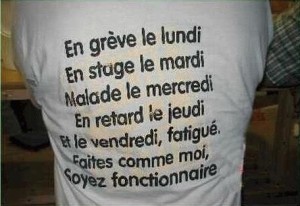
In Quebec, Valentine's Day is a Union Holiday

Here's what's going on in the world of Quebec unionism, this week;

St. Valentine's Day a paid union holiday
It seems that for some unionized health employees in Quebec,  St. Valentines Day has become a paid holiday. Link{Fr}
Yup....I'm not making this up.

Several health care facilities were closed to out-patients including;
* CSSS de Drummond
* CSSS Thérèse-de-Blainville
* Hôpital Maisonneuve-Rosemont
* CSSS Pierre-Boucher
* CSSS de St-Jérôme
* CSSS d'Arthabaska-et-de-l'Érable
* Centre de santé Thérèse-de-Blainville
...plus a bunch of CLSCs as well.

Certain hospitals  were working with a reduced staff including Saint-Jérôme, St-Eustache, Maisonneuve-Rosemont, Pierre-Boucher and others.

In the St-Jérôme hospital, in an effort to save embarrassment, management decided to re-baptize the holiday as "Winter Break"
Some unionized health facilities also celebrate "Woman's Day." Unionized employees in the health care field enjoy 13 paid holidays as compared to the 8 statutory holidays Quebec workers are afforded by government decree.

Now that I've got you shaking your head in disbelief, let's continue;


Female University employees awarded huge pay equity settlement.
Longtime female employees of several French language universities hit pay dirt with the announcement that a settlement has been reached between the union and the schools in relation to the pay-equity legislation that the government passed many years ago.
The settlement is retro-active back to 2001 and so for longtime employees it's a bonanza. For a telephone receptionist who was working steadily since 2001, it means close to a  $20,000 settlement and for an executive secretary it means closer to $60,000. Not bad!   LINK{Fr}

White collar office workers refuse to water their plants
White-collar employees of the City of Sainte-Marthe-sur-le-Lac are refusing to water the plants in their office forcing the municipality to pay a private company to do so. "I wasn't hired to water plants. We didn't study for it and it's not related to our work. If we are asked to sweep the floor, even if it doesn't take much time, it's not our job" said the union representative. 
The small municipality was forced to hire a private contractor to come and do the plant watering. LINK{FR}

Union boss accused of ties to the mob
Bosses of the much-maligned CSN Construction union are red faced over revelations that the head of a union local is a well connected criminal.
Dominique Bérubé, head of Local 618 (pipe fitters and insulators) is closely connected to the Mafia, and was  photographed attending the funeral of slain mobster big shot Nick Rizzuto. When he was convicted of running a grow-op back in 2003, he shared his lawyer with prominent members of Quebec's biker gangs. Union bosses have claimed that they had no idea and are asking for ..errrr.. an explanation. LINK {Fr}

School bus drivers' strike strands students
"Students in three South Shore school boards may be without a ride to school for some time as about 80 school bus drivers started a strike Tuesday against their employer, Transdev Limocar. As many as 36 schools are affected in total."  LINK 

Labour woes paralyze Que. justice system 

"Quebec's legal system is increasingly paralyzed by labour disputes. Prison guards charged with ferrying inmates back and forth from the courthouses walked off the job this morning. LINK
Add that to the week-old strike by government lawyers and Crown prosecutors, and not much was happening this morning at the Montreal courthouse.
About 1,450 lawyers and prosecutors have, over the last week, traded in their black robes and briefcases for union pickets.
The lawyers estimate they're paid 40 per cent less than counterparts in other provinces." LINK
Unionized Foster parents demand contract with government 
About 10,000 foster families held a large demonstration in front of Premier Charest's office in Sherbrooke to complain about the slow pave of negotiations in relation to their first contract   LINK  Video{Fr}

Denim factories set to close
Unable to compete with Chinese competition the last of Quebec denim factories announced that they are set to close July 15, throwing 400 mostly women out of work. Once the home of thousands of well paid textile workers, the Beauce region has seen clothing factory after factory close over the years. LINK{FR}

Longueuil Buses set to strike
Users of public transit in Longueuil could be deprived of service outside of peak hours sooner than expected, confirmed Tuesday the president of the union of bus drivers Network transport de Longueuil (RTL), Michel Robidoux. LINK {Fr}

Union appealing court decision to Supreme Court

The CSN is appealing a Quebec court of Appeal decision that backed Olymel, who closed their pork abbatoir in Saint-Simon. LINK{FR}

Quebec unions seek to muzzle bloggers
The Centrale des syndicats du Quebec (CSQ), sent a letter to the web managers of the right-wing blog, lesanalystes.ca  demanding that  they retract comments that union bosses found offensive. The “offensive” terms? The bloggers said those on the political left are mainly made up of “old ladies” and “effeminate men,”  Toronto Sun    National Post

CSN to union Couche-Tarde
The powerful union is mobilizing to unionize employees of the convenience store chain. It remains to be seen if the powerful company will pull a 'Wal-Mart' and close any store that falls to the union. Link
************************
Here's some interesting anti-union articles appearing this week in the media;

We need a total overhaul of Quebec's labour laws- Montreal Gazette

Anti-scab law benefits unions: Conseil Montreal Gazette

The Quebec unionization model: correcting the anomaly  Montreal Economic Institute