Friday, March 4, 2011

French versus English -Volume 23

SAQ accused of colonialism
Michel Phaneuf, a big shot Quebec wine connoisseur who writes an annual guide to the wines offered at the SAQ, the Quebec liquor monopoly, has taken the organization to task for partnering with an American wine expert, James Suckling, in a promotion.
Obviously annoyed he offered this pearl; 
"The SAQ does not need to do this. It is a form of colonialism. Like an American opinion is better than another. It seems to me that Quebec, with all its talent, editors, critics and sommeliers need not rely on the opinion of a Californian columnist"
Colonialism? Actually, it sounds more like sour grapes to me!

OQLF to attack English Store names
Louise Marchand-very professional
Last week I caught some heat for calling the new director of the l'Office québécois de la langue française (OQLF) ugly, so from now on I shall refer to her as the 'very professional' Louise Marchand.  She happens, by the way, to be in a bit of a snit over the fact that in the Saint-Roch district of Quebec City, horrors of horrors, she spotted an Urban Outfitters store alongside  Mountain Equipment Co-op, not far from City Café.

And so the 'very professional' director of the OQLF has set herself a goal of francizing the names of stores such as American Apparel, Old Navy and Feetfirst to reflect the fact that they are operating in Quebec. LINK{FR}
Unfortunately for her, international law protects the intellectual property of company names and so her hands are somewhat tied. No doubt we will see another SECOND CUP imbroglio wherein the company was forced to add the word "Les cafés" before its name to satisfy the language hounds. How would I describe this state of affairs.....'very professional.'

The OQLF has found itself tongue-tied in the affair of SKI IN/SKI OUT  hotels a new type of lodging that allows skiers to, as you might have guessed it, ski right up to the door of their lodging. 
These type of hotels are sprouting up along the hills of many Quebec ski resorts and the appellation seems to have stuck.
As of yet their are no suggestions for French alternatives. LINK

Interviewed in a Quebec City newspaper Madame Marchand warned Quebeckers that it's their responsibility to protect the French language and as such, when speaking with anglos or ethnics, they should stick to speaking French only.... How 'very professional' of her!

I received an email from Steve asking what the annual budget of the OQLF is...
The answer..... a little more than $20 million.


Student complains about English course material
 "The case has not made much noise, but nevertheless reveals a disturbing trend. On February 4, in Le Devoir we learned that a student at the University of Montreal believed herself to be a victim of language discrimination. Enrolled in a Religious Studies, Marie-Noelle Smith had to retire from the very first course because 80% of reading material was in English. "Does it mean that higher education is accessible only to a bilingual elite in Quebec? "She asked anxiously.  
The Ombudsman of the university responded that French is fine, but it must first seek "the highest standards of quality ."  Le Devoir

French dictionary makes a stink
A Montreal Gazette writer humorously noted that a French dictionary was placed in the Foreign language section of a Montreal bookstore.
It was funny until Josee Legault, the Montreal Gazette resident separatist made a big deal about it and sent the story viral.
Always ready to find something to feed her persecution complex she played up the story as something significant instead of something just plain dumb.
Read Andy Riga's story

Anglos ask for English health services in Trois-Rivieres
The small but not insignificant anglo community of the Three-Rivers Trois-Rivieres region has been politely militating for English services in the health care field.
As of now no English services are available anywhere in the region and anglos say that being hospitalized without being able to communicate represents a hardship, especially to the elderly. Bilingual hospital employees are few and far between in the region. LINK

English cegep demand up again this year
Last year saw a 20% rise in the demand for places in Montreal area English cegeps. The increased demand put pressure on students to produce higher marks to earn entry and many were disappointed. The schools increased enrollment after securing a promise from the education department for increased funding.
To date, the money has not been paid and schools are facing another crisis as enrollment is up considerably again this year.
"Dawson College allowed 300 additional students, while John Abbott admitted an extra 175 students, and Vanier added 204.
But none of the schools has actually received any of the new money yet, and the long-term plans for the provincial funding are still up in the air.
Meanwhile, demand to register for the Quebec junior colleges increased for the third year in a row this year, with parents lining up Tuesday at CEGEPs like Dawson College in Montreal on the last day to register students for next fall.
Some CEGEPs have been forced to reject thousands of students in recent years because of an inability to accommodate the demand." LINK CBC news
Renowned Montreal lawyer warns of lawsuit if  Bill 101 applied to cegep
“If an eventual Parti Québécois government decides to extend Bill 101 to CEGEPs, a prominent Montreal lawyer predicts it would be quickly challenged in court.
“I would join in any challenge and I would perhaps personally challenge it, as well,” said Julius Grey.
“I consider academic freedom to be a fundamental issue. And I don’t think a society should play around with higher education and with restricting what people may do.” LINK
In an interview, ex-separatist Premier Lucien Bouchard advised against applying the English restrictions of Bill 101 to cegeps;
I think we have reached a linguistic balance in Quebec. It's fragile, it's not a perfect balance. But at the risk of losing it, we must accept to live with it. LINK{FR}
Rural Anglophones a vanishing breed
“Quietly, without fanfare, English-speakers are disappearing from regions where the roots of both language communities run deep....”

“...150 years ago, the Eastern Townships had more English-speaking residents than Montreal, points out Ronald Rudin, a history professor at Concordia University who spoke at a conference there last week on the inclusion of anglophones in Quebec history. In 1861, anglophones formed one-quarter of the population in the Gaspe, 39 per cent in Quebec City and 64 per cent in the Ottawa Valley...”
Read an outstanding article by Marian Scott about Quebec's vanishing Anglo rural  population.
Rural anglophones a vanishing breed in Quebec

More blowback about grade 6 bilingualism
More progressive thinking on the subject;

"It isn't true that all humans can learn two languages perfectly. Only 10 to 20% can do so without it interfering with their culture. The rest learn their own language poorly or the other imposed language. That's time and money lost.
Everybody says, even today, after 150 years of public education, 35% of people are illiterate to the point of being unable to cope ... and 30% of students are dropping out of high school ..
Where does this madness of trying to impose a second language come from? Speaking  English in Quebec is only required by about 15 to 20% of people. If Bill 101 was implemented, it would be even less.- Onil Perrier
"The teaching of English in the first year in Quebec schools would be a disaster," says French linguist Claude Hagege.

"In another language environment, the teaching of English in the first year would be questionable. But in Quebec, such a reform would have serious consequences with only six million francophones in a sea of 300 million anglophones. The natural evolution is  towards English. French may disappear at any time if English is not severely and strictly forbidden by law. "

"Quebec Francophones must stop believing that in the holy name of globalization, they can thrive and prosper by becoming bilingual. This is a dangerous slippery slope, the consequences will be disastrous for the survival and future of an entire people. React while there is still time!
Claude Verreault, Department of Languages, Linguistics and Translation
  University of
Laval,
"As we saw in the case of bridging schools and as we see now, the decision to require all sixth graders to be subjected to half a year of intensive English, is the Liberal party dream to bilingualize Quebec from one horizon to another, regardless of need and cost." -Yves Rancourt

"No need to look at the numbers to understand that Quebecers are among the most bilingual in the world. Bilingualism is symptomatic of a language imbalance, it is the first phase of a process by which a foreign language is to supplant a local language. Bilingualism in Quebec is one way: Francophones in Montreal or Gatineau speak English to be understood by English speakers, who have no need at all to learn French to be understood. That's the magic of bilingualism." -Daniel Sénéchal

Thursday, March 3, 2011

Only in Quebec is a STOP sign a Language Issue.

I thought that the once simmering "STOP sign" controversy was long over, until reading some recent posts on French language militant websites where it appears that the subject has reared its ugly head once again.

You'd think that with the province drowning in debt, the health care system on the verge of a collapse, the dropout rate among francophone teens an utter disgrace, one wouldn't have the time or energy to debate such a mundane subject as STOP signs, but such is not the case.

This is Quebec.

In another century, this cartoon by Montreal Gazette cartoonist Aislin, said it all, the sad pettiness and vindictiveness that characterized the issue.

When the Parti Quebecois first came to power, it became public policy to sanitize all road signs and slowly over the years, English slowly disappeared from road signs across the province, in all but a few officially bilingual towns.

And so Quebec's distinctive and beloved bilingual STOP/ARRÊT sign went the way of the dinosaur, replaced by the unilingual ARRÊT.

The inconvenient fact that the word 'ARRÊT' is not really proper French to describe the act of coming to a stop at an intersection was of no matter. The word ARRÊT' can be best used to describe a stop as in a "Bus Stop" In fact the proper French word for coming to a halt at an intersection is.......wait for it.....STOP or STOPPEZ.

In France 'STOP' is what is written on their stop signs, believe it or not.

In fact most countries in the world, especially in Europe, employ STOP and nothing else on their signs.  For an interesting picture gallery go here.

That being said and Quebec being what it is, the idea of 'STOP' on signs no longer sat right and so the grammatically incorrect ARRÊT was decreed politically correct.

Last summer, I filed what I thought was an amusing post about Stop signs for further reference, believing it to be an atypical rant, something that perhaps didn't deserve to be critiqued on its own.

But last week another Stop sign complainer graced the pages of another militant French language website, so I decided to take a closer look at the complainers, where sadly I found, a particular twisted state of mind, one that still exists in Quebec, to what extent, I cannot really say.
 In Dorval near the Airport

If you live in the greater Montreal area, you may have noticed these last years that "STOP" signs have slowly begun replacing the now familiar ARRÊT or ARRÊT/STOP signs.

Apparently the powers that be, have now decided that Quebec has matured to the point where STOP can be employed alone, rehabilitated like a political prisoner who spent a decade in the Gulag.

But of course this doesn't sit well with some language militants who are outraged that such an affront to the French language is going unchallenged and so they have taken up the good fight to keep French pure and to police words like STOP from entering the common French lexicon.

You'll remember that during the francization campaign to remove English from road signs, the common ARRÊT/STOP sign was particularly galling to French militants because it reflected a bilingual society, nothing less than an anathema to them. And so the innocent STOP/ARRÊT sign was treated to a cruel onslaught of vandalization.

Here's an interesting exchange on the Mouvement Montréal français website LINK
I'm surprised that nobody is talking about it, but have you noticed that the city of Granby has retained its stop signs that say: "Stop" while the rest of the province, we see "ARRÊT". Is this city exempt from the Bill 101?.... 
....I can't accept to live in English in Granby while the rest of the province lives in French"

"I spoke with Mr. André Jean, Public Works of the City of Granby, today and he replied that the word "Stop"is legal and comes from Old French (?) that the word is in the French dictionary and that the word is accepted OQLF and MTQ. It is the word "ARRÊT" that is not the correct French term and the government accepts these signs since 1978. They are accepted by the road signs manual of Quebec accepted as well as everywhere in the world, even in Germany, he told me. I asked him for a copy of the report and  will check it out...."

"The word 'STOP' is French and has been for a hundred years! I agree that the word STOP on a sign gives the impression of English monolingualism. On the other hand the word ARRÊT is less acceptable because in general French, this term refers to a bus stop! I do not understand why our signs don't display 'ARRÊTEZ' or something similar in Quebec. Can someone give me an opinion on this?
Hmmm. a whole big discussion. Here is another reader exclaiming outrage last week in another post vigile.net
"The real significance of these 'Stop' signs is that it is an act of defiance towards Quebec. In Quebec the stop signs that say 'ARRÊT' are a symbol of the survival of French in North America. Remember that Quebec is the only "state" in the Francophone world that writes ARRÊT on its signs. This is a legitimate way to tell the world that we exist. These signs are somehow inscribed in the cultural heritage of Quebec.
Westmount with STOP signs reject Quebec, flouting Bill 101, ignoring the minority, helping to create and maintain the two solitudes in Montreal." LINK
Can you believe all of this over stop signs?
Incidentally, this writer of the above post must never have been west of Decarie Boulevard in Montreal. Had he visited Hampstead, Côte St. Luc and practically every other west island community, he'd have found the same STOP signs widely in use.

Incidentally, a public works employee told me one of the reasons for using the 'STOP' sign is because they are cheaper and available in bulk from suppliers across North America. Hmm....

The stop sign debate even crosses over to the native communities in Quebec where natives, like all  Quebeckers, are divided along linguistic lines.

Stop signs on reservations reflect this French/English divide wherein  bands that speak English display bilingual stop signs with English while those bands that speak French display bilingual stop signs with French.
Some signs are even tri-lingual.

At any rate I don't think the OQLF or Transports Quebec will have much influence on what the natives display on their resevations!

My least favourite Stop sign is one that remains in the parking garage of the Westmount Square parking complex. Not only is it insulting, but completely stupid, no doubt the product of a nincompoop employee making a bad decision.

On the other hand my favourite stop sign is this one that appeared last Spring as the Canadiens were making a heroic playoff run.


Ah, Quebec! always interesting.


Wednesday, March 2, 2011

French language Militants Organizing to Fight Grade Six Bilingualism

One of Quebec's dirtiest little secrets is that the powers that be, the entrenched educators, most politicians, the unions and the civil service, all share a unique view of Quebec as a unilingual country/province, where English should be discouraged rather than promoted.

This of course doesn't jive with what the general public wants, a province which is French, but where every child is taught to speak English as a matter of public policy.

In a battle of wills, it's not hard to predict that it will be the powerful and entrenched, French-only militants who will prevail in imposing their view of a unilingual Quebec on the powerless public.

Premier Charest's pronouncement that sixth grade school children will be treated to half a school year of English immersion sent sub-surface shock waves throughout the intelligentsia who view this possibility as a dangerous development, a project to be nipped in the bud as soon as possible.

The reality is that the Premier's promise of English immersion is another pipe dream, similar to the promise he made during the last election campaign that we could expect reduced wait times in emergency rooms.
Both are lofty ideals, but unfortunately neither is attainable in present day Quebec.

And so six years after the Liberals took power with the promise of improving wait time in the emergency room, Quebec has sunk to last place in North America, where it takes an average of  1026 minutes or about 17 hours to be treated, wherein the average in the United States is 240 minutes. LINK

Better to move the public debate to a new and different unattainable promise than to mire in the failure  of the past.

For the powers that be, keeping Quebec unilingual is viewed as a necessary evil that protects and maintains the French language and Quebec's unique culture. The present day policy of functional unilingualism acts as the  'FRENCH CURTAIN' that envelopes Quebec's borders and keeps citizens from exercising free movement due to their inability to communicate with the outside world.

Author Christian Dufour, sums up neatly the pathological fear that many Francophone intellectuals share;
"If all Quebeckers become very bilingual, they will buy more records, newspapers and books in English. It will create a decline in interest for our cultural products, already heavily subsidized. ...
"It's a a regression of identity, It means that those who do not speak English are not functional, as if being French no longer sufficed, that English was a necessity to exist.
LINK
In a letter to the editor a reader, dead set against the teaching of English summons the same hackneyed excuses that are the hallmark of bilingualism foes.
" Although I think the teaching of English should be improved in Quebec, I disagree with the government's plan mandating the exclusive learning of English for half of the 6th year, compressing all other academic subjects in the other half. Where will we find the specialist teachers who will be needed? Teachers are already in an impossible situation, that is, to integrate students with learning disabilities in regular classes. Now we want every child, whatever his strengths and weaknesses, to become bilingual while assimilating a school year in 5 months"
And so support for the existing FRENCH CURTAIN of ignorance remains strong and like the IRON CURTAIN of the communist era, it may be cynical and cruel, but undeniably effective. Francophone Quebeckers are the least mobile of all Canadians and are culturally and linguistically dependent on the province, like an infant attached to its mother's breast, a pleasing state of affairs to militants.

Take for example the exodus of newly-minted anglophone doctors who are exiting the province at a rate of about 50% due to the gross iniquity in remuneration and working conditions as compared to any other place in North America. Yet francophone colleagues remain steadfastly at home, tied to the province through the language and cultural handicap.

For language militants and separatists, this represents a happy state of affairs, not something to be trifled with at all.

And so unless you are a unionized government employee (including government corporation like Hydro-Quebec)  or a unionized construction worker, working in French in Quebec means working for less money. The lack of worker mobility because language is the number one factor.
It's no different than the bygone practice of controlling women by keeping them "barefoot and pregnant," a cynical device to keep women in their place.

Nobody can deny the effect of Bill 101 in transforming Quebec from a bilingual to French only society. The higher echelons of elected government, the bureaucracy, state controlled business have all eliminated English completely from daily affairs.
Years ago politicians, even separatists were fluently bilingual, including René Levesque, Jacques Parizeau, Lucien Bouchard, Daniel Johnson, André Boisclair and even Bernard Landry.
Today's politicians, Liberals included, can hardly speak a whit of English and this includes Liberal cabinet ministers who sound like tourists reading out of a handbook when speaking English.

Unlike the citizens in the street, most of these leaders remain firmly planted in unilingual Quebec society and cannot really see the utility of English.

And so the backlash begins.

Of course the French radicals who populate the Société Saint-Jean-Baptiste, Mouvement Montréal français and the majority of readers and writers on vigile.net have no qualms about opposing this bilingualism initiative on principle, but they are of no import, they have zero power.

The meaningful push back will come from those who have the political power and will to sabotage the bilingualism project from the inside. These are the politicians, the school board officials, the teacher's union who will pronounce themselves firmly in favour of bilingualism...with an asterik.
They will cleverly support bilingualism publicly, but work to sink the implementation of any such project from the inside.

Yves Parenteau of the Teacher's Alliance;
"We already had trouble teaching all the content in the other subjects. The problem will worsen if we have to steal time
from other disciplines in order to teach  English" LINK{FR}

There is really no political will to speak of in the French school system to teach English. While everybody pretends that it's a good idea, the entire system will fight to keep English out.

The teacher's union, which doesn't have members with the capacity to teach English will fight tooth and nail to keep Anglophone teachers from replacing unilingual francophone teachers and that's just a start.
The ideologues throughout the system, be it the Ministry of Education, the school commissions and the teachers themselves will work to frustrate any plan to further the teaching of English.

In the meantime a policy of misinformation, ignorance and misdirection towards the teaching of English continues unabated in the media

A recurring theme in many of those complaining about the proposed language training, is that it isn't fair that English students will not be subjected to the same intensive training in French. Here's a typical complaint{FR}

What an ignorant fool!

Most Francophones remain entirely ignorant of the efforts of the English community to teach French intensively to their children. Here in a letter to Le Devoir by Jean-Michel Brunet, a French teacher in an English school, sets the record straight LINK{FR}
By the way, as most parents can attest, this intense French language instruction doesn't turn the children into francophones, but rather, bilingual anglophones!
Intensive French instruction for English students has been in the curriculum of English schools for over thirty years, with French immersion and general language starting in kindergarten.

Gilles Proulx, the French blowhard radio and television personality, gratuitously claims that English high school students can't speak a word of French, a lie that only an ignorant fool would propagate.

French educational 'intellectuals' continue to weave the fiction that starting young children on second language instruction is dangerous and confusing, a concept that runs counter to what the rest of the world believes.
The myth that learning English turns Francophones into Englishmen is perhaps the most monstrous of all the distortions propagated, yet we hear it every day.

Look for this project to teach English intensively to die a death of a thousand cuts. While nobody will admit to it, there will be an insurmountable campaign to scuttle the plan because while educators agree that learning English is important, they aren't really in favour of it.

And so it remains that your typical francophone high school graduate cannot ask for the time of day in English and come to think of it, neither can their teachers.

Parents who seek English for their children will do what they need to do, outside of the system.  More kids learn English by playing video games and watching English television and movies than through the entire English training provided by the French educational system.

Francophones who learn English do so on their own, by their own ingenuity and effort, and they should be congratulated.

In acquiring English they never could count on the support of the French educational system and sadly, notwithstanding Mr. Charest's announcement, they never will.

Instead of looking to the English school boards as an example of how to properly teach a second language, the government is setting out on a program doomed to fail from the start. Every English parent who has sent their child to English school where French is taught intensely, knows that it takes years of training and that the earlier the exposure to a second language starts the better.

French language militants who want to keep franncophone Quebeckers unilingual, should applaud Mr. Charest's effort.
As the greatest English playwright said in Macbeth - it is a case of;
  'Sound and fury, signifying nothing"

Tuesday, March 1, 2011

Royals Protest by Quebec Miltitants a Crashing Bore

Once more the self-important, paper tigers of RRQ has threatened to disrupt a royal visit, this time that of Prince William and his soon to be wife Kate Middleton, this summer.

The real question is -Who cares?

The Royals are no longer the symbol they once were, not in Britain, not in Canada and certainly not in Quebec.

Fifty-two years ago as a young lad, my mom dragged me off to greet young Queen Elizabeth, who was in the midst of the greatest Royal tour of Canada ever, a 45 day coast to coast visit that brought her to Montreal and a stop at the St. Justine Childrens Hospital on busy Cote St. Catherine Boulevard. The well-wishers were lined six-deep for kilometres in each direction and as her motorcade passed by ever so slowly, I was prompted to furiously wave my paper red ensign. Interestingly, the visit by young Queen Elizabeth went extremely well in Quebec, where she was actually praised in the press and referred to as 'sympathique' by the Montreal Matin newspaper.

Sounds a little ridiculous today.

Few of us care about the Royals, other than those predisposed to celebrity fan magazines, where one can live the glamorous life vicariously.

For many of us, the only time we pay any attention at all, is when a Royal marriage is melting down or when they act rather foolishly in public and then with a cruel sense of schadenfreude, we take perverse delight in the very public humiliation.
There are very few of us left who view the Royals as some sort of dashing symbol of British imperial power or alternately, depending on one's point of view, as a vile representation of colonialist power.
They are in reality just not that important.

Canada's relationship with the monarchy continues to fade and truthfully, we maintain the tradition more out of politeness than anything else.
Like our membership in the Commonwealth of Nations (which has officially dropped the "British Commonwealth' moniker) we can ask ourselves why on Earth we remain a member.
Membership in that organization has us rubbing elbows with tin pot dictatorships and countries that routinely advocate killing  homosexuals (Uganda). The Commonwealth Games is a celebration of also-rans that is embarrassingly un-competitive. The last edition in India was an a utter flop and a considerable humiliation for the host, unable to cope with the complication of holding an international event of that magnitude.

To Canada, the monarchy and the Commonwealth are the past, a historical reminder of the way things were.

So what is it about the royal visit that has the RRQ so annoyed, other than the fact that each Canadian taxpayer (Quebeckers included,) contributes about a buck-fifty each per year for their upkeep. Hardly something to riot over, I'd imagine.
Even the radical Jeunes Patriotes du Quebec said that the royal visit was a non-issue for them.

The RRQ is a sad little collection of coffee house revolutionaries, too chickenshit to cause any real damage and this by their own admission. The fact that they have promised to keep things civilized makes them about as interesting as a bunch of civil servants conducting a protest march over job security.

Its hard for the organization to muster 100 people and so with a little forethought and planning the police could easily deflect any inconvenience the group hopes to achieve.

By picking a large venue, outdoors on Mont Royal or in the old Port, for example, with more than one entrance and exit, the effectiveness of the small demonstration could be neutralized.
Last time the police played right into the demonstrators hands by failing to block off two streets leading to the armoury where Prince Charles and Camilla visited. Ten cops, and correctly placed barricades was all it should have required but alas, the Montreal police are not known for stellar crowd control.

In the old days of the FLQ, Quebec revolutionaries sat in taverns, smoked Gitanes and drank from large brown bottles of Molson. Today our pseudo-revolutionaries sit in Van Houtte drinking $5 Lattes and munching on croissants.
The RRQ are a harmless set of twits, who huff and puff. They should be ignored.

While on the subject of pseudo-revolutionaries, a small article in the news caught my attention.
Do you remember our good friend Jean-Roch Villemaire who was convicted of crimes related to vandalization of anglophone candidates political signs because they were in English?

Well after lying low after his conviciton, he re-emerged as the head of the Mouvement Nationaliste Révolutionnaire Québécois (MNRQ) a neo-fascist movement, which proposes the elimination of English from Quebec as well as an end to immigration. Thrown in for good measure is a heaping helping of anti-Zionism.

Recently his announcement that his organization would participate in the boycott of Le Marcheur freaked out the PAJU, who didn't want to be seen allied with the right-wing supremacist organization.
They issued this press release which referred to MNRQ as Nazis, and called a temporary halt to the boycott. LINK

Following virulent denunciations in the press, including that of Francoise David of Quebec solidaire, Mr. Villemaire announced that he was tired of being vilified and misjudged. In a final statement before shuttering the organization the MNRQ announced.
"We can draw the necessary conclusions from this adventure. The forces of status quo are powerful. The demonization campaign orchestrated by the Zionist lobby towards Jean-Roch Villemaire and MNRQ has unfortunately been victorious. We lost a battle but we have not lost the war! "

Good to his word, the website has been shut down and hopefully Mr. Villemaire will fade to black.
He was a dangerous little fellow.

Not so the RRQ, a harmless group of wannabee revolutionaries who are about as popular as they are dangerous. They are actually amusing casting their empty threats with mock indignation. Perhaps when they are finished with the Royals they can launch a protest against the Catholic Church, the Equality Party and other irrelevant and spent forces.

By the way, when they do protest the Prince's visit, I hope they will improve on the poor syntax displayed on the protest placards (see above) they brandished last time. Maybe they should hire someone who could advise them on the proper use of English!

Monday, February 28, 2011

Péladeau Slays the Union Dragon

It took two long years, but the Battle for the Journal de Montreal is over.

This weekend the union finally admitted what everyone already knew, that they were toast.

Deciding to put an end to the agony, the union accepted by a margin of 64% to accept an offer they rejected by 90% last October.

For the 265 workers locked out, only about 65 will return to work, the others made redundant, but walking away with around $100,000 in termination payments. Still not bad for getting crushed.

Dejected union leaders sounded like the late Ayatollah Khomeini who in accepting Iran's ceasefire and end to the hostilities with Iraq, described it like 'Drinking a cup of poison.'

Union leader, Raynald Leblanc, described it as a day of mourning and André Fortin, a CSN representative blamed the scabs that were permitted to work by crossing the picket line electronically.

But his bitterest denunciation was aimed at the public which refused to heed calls for a boycott of the newspaper, which actually saw circulation and advertising revenue increase during lockout.
To the union, it seemed that the public was siding with Pierre-Karl Péladeau but truth be told, most people didn't give a hoot, one way or the other. It was perceived quite rightly as a battle between a powerful union and a powerful corporation and so to the public, it seemed that they had no dog in this fight.
The reality is that the JdeM has become a better newspaper with the 'professionals' gone.

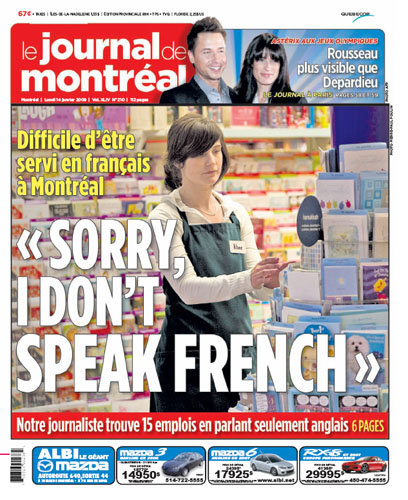
Before the lockout, the focus of the newspaper was to bash anglophones with such wonderful articles such as this pearl; "Sorry I don't speak French," an article wherein the paper sent out a reporter pretending to be unlingually English, to apply for about 20 minimum wage jobs in Montreal's downtown. Since the reporter landed 16 of the jobs, it was determined by the newspaper that French was on the decline.
A Montreal Gazette reporter Andy Riga countered the article with his own unscientific test which proved quite the opposite. It's a good read.

But back to the knitting.....
Ever since the employees were locked out, the paper has improved dramatically.

The QMI agency that PKP set up to provide alternate, content has done a bang-up job and the stories are crisper, the graphics more exciting and the exposés balanced and devastatingly on point.

The younger Journal writers sensed what the older locked out veterans hadn't noticed, that bashing anglos was no longer something that most readers were particularly interested in. Truth be told, other issues have long surpassed the traditional anglo/francophone chicane, which has, over the years considerably weakened. The old stories of 'Speak white' and Simon Legree English bosses are gone and no longer a fair representation of every day Montreal life.

Perceptions have changed and if anything the new 'persons of interest' are the immigrants who 'appear' to be taking over the city and those religious-nicks demanding reasonable accommodations.

But by far the biggest change in the JdeM is balance, with the paper hiring columnists that are separatist, right wing 'tea party conservatives,' as well as middle-of-the-roaders. It's an eclectic mix that has Gilles Proulx writing opposite Eric Duhaime and it makes for good reading.

That being said, nothing but nothing, signals the new direction of the paper like the very popular and almost daily attack on government waste and all manner of politicians. Nobody is spared.
Each week, we are treated to delicious stories of civil servants wasting our money. Unionized government workers are given a very special rough ride with stories showing them loafing, sleeping and attending unproductive feel-good events on the public dime.
Politicians of all stripes are mocked with a decidedly sarcastic tone which the public seems to adore! 

A new an wildly popular feature is the weekly list of grants given out by the ever generous provincial government.

GREAT STUFF!

Pierre-Karl Péladeau has proven one thing with his lockout. That a better product could be put out for less money, once the union is busted.  It's a dangerous precedent, even with Quebec's anti-scab laws.

Bosses stuck with unproductive, overpriced unionized shops will look to win some sort of relief.
Although they can't hire replacement workers, there are other strategies.

I recently visited a friend's factory where he proudly told me that his union problems were a thing of the past. When threatened with unionization he fired all the employees and contracted out. Now the workers belong to another company. If they go on strike, it's not against his business and he's free to hire another sub-contractor.

I know of another factory that hires two different ethics group that compete with each other for jobs in the factory. The internal competition between the groups for supremacy keeps the union at bay. Any unionization threat will be countered by more jobs going to the ethnic group that promises loyalty.

The new Quebec......

Further reading;
Pierre-Karl Peladeau Poised to Become Canada's Next Media Scion