Wednesday, May 9, 2012

$7 Daycare Defines Quebec as Fiscally Challenged

 "...Denis Coderre, the politician, exclaimed that $7 daycare, "defines us as people." A professor at the University of Montreal adds, solemnly, "it is a symbol of Quebec's identity!" Link{Fr}
I actually agree with these two, but as you can imagine, not in the way they imagine........

For many taxpayers across Canada, watching Quebec's orgy of social spending, spiraling ever upward (much of it financed by taxpayers outside Quebec,) can be an infuriating and frustrating experience;

Many of you ask yourself quite openly; "Are they nuts, or am I?"

Seven dollar a day daycare, extended maternal and parental leave, low tuition rates for post secondary education, free in-vitro fertilization, cheap electricity rates, free prescription drugs, etc. etc.
On and on the list goes and it sounds like a famously good deal, a recipe for social harmony where people may pay more taxes, but receive so much more in benefits.

Many, if not most Quebecers are proud of the system they have created. Defenders of the mommy-state model, known in Quebec as the 'Gouvernemaman,' claim that Quebecers fund the system through higher taxes, (38% in Quebec versus 31% in Canada) and that it is a deliberate societal choice to pay more taxes for more services. 
In this respect, Quebec citizens may be unique in the world.

But is Quebec's policy of tax and overspending really something to be proud of?
More importantly does it make for a healthier and happier society? Hmmm....

The first thing to consider, is that as things stand today, the 'Gouvernemaman.' is not sustainable.

Even with transfer payments from Ottawa, there is not enough money coming into the government coffers to pay for the entitlements and so heavy borrowing has raised the province's debt load five-fold since 1984, making Quebec one of the most indebted societies in the world, a fact defenders of the system conveniently ignore.

Now comparing Quebec society to say, that of Alberta, which despite being wildly more affluent, doesn't offer these extended social services is difficult, because Quebec finances a part of these services with debt.
It's like comparing your lifestyle to that of your neighbor who is living it up on credit card debt, while you dutifully pay off your bills each month.

But putting the debt problem aside and with all other facts considered, an impartial observer would still come to the conclusion that the Quebec model is an unmitigated disaster.
In fact, it is so dysfunctional, it should serve as a global example of what can go wrong when governments run amok.

The first thing to consider, is that the Quebec government, despite the enormous taxing and borrowing, must still rob other programs to help pay for these perks and benefits.

The health system is so under-financed that waiting lists for surgeries extend into months and months and sometimes years and years. Hospital emergency rooms are operating at an average of 130% capacity and patients have an average wait of about twenty hours before being looked after.
Quebec has the highest penetration of private medicine of any province with services from the diagnostic to actual surgeries being offered for pay. The government turns a blind eye, because it is helping ease the congestion.
The wait time for a colonoscopy in one Montreal hospital is up to four years and so doctors unauthorized to do the procedure by the health board are offering patients a private alternative for about $500 to $600.
How do you spin the fact that 25% of Quebecers don't have a family doctor?
According to Health Minster Yves Bolduc, we should look on the bright side, the fact that 75% of Quebecers do have a family doctor!

Quebec roads and bridges are so neglected that having an overpass come crashing down or a bridge falling is something that Quebecers come to expect. Everyday, roads overpasses and bridges are closed on an emergency basis to effect emergency repairs that are usually nothing more than patch up jobs.
While Quebec students boycott classes to lower, some of the lowest tuition fees in Canada, the  university system is woefully under-financed.

Let's look at a poster boy of Quebec's social programs, the famous seven dollars a day daycare, which defenders have the audacity to tell us actually makes money for the government.
"Pierre Fortin, an economics professor at the University of Quebec at Montreal, presented his findings that for every dollar Quebec invests, it recoups $1.05 while Ottawa receives a 44-cent windfall."
 UQAM, need I say more?

Yup, defenders of the program, live in a fantasy world where every dollar spent by the government on daycare returns $1.49.

As one blogger pointed out, if such is the case, the government should pour billions and billions more into the system, filling all the demand for daycare places while making money to boot!

Such is the fantasy of the deluded and those who want to be deluded, including a Montreal Gazette columnist, copy and paste expert, Janet Bagnall, who repeated the outrageous nonsense here.

The first contention of these defenders, is that the subsidized daycare program has successfully put 70,000 Quebec women back to work, who would otherwise stay at home.

Poor Alberta, without $7 a day daycare, the province must be lagging far behind Quebec in the number of women in the workforce.
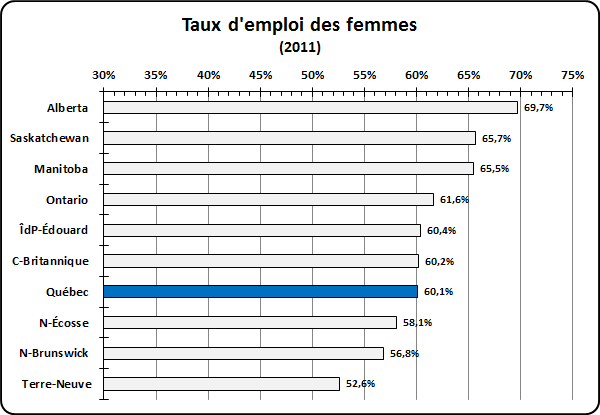
Credit l'antagoniste
errrr.....maybe not!

Nobody will deny that daycare allows women to return to the job market, but it is the cost of this daycare program in Quebec that is so outrageous.
Because the government runs daycare, employees are no longer babysitters, but are now unionized 'educators' and make up to $20 an hour plus benefits.

When first created in 1997, the subsidized daycare program (with non-unionized employees) had about 100,000 children in its care, at a cost of 526 million.
Today the program has a little more than 200,000 children (a little more than double,) but costs over 2 billion dollars, almost four times as much!

And of course, being unionized brings the added benefit of mandatory strikes and work stoppages every now and then.
Read a sad history of the program.  Historique des CPE{Fr}

Notwithstanding, those who defend the program, tell us it is money well spent, because it creates employment and economic activity.

They should all be forced to watch this video.


Let's break down the millions and billions spent on daycare by the government to numbers that we can comprehend.

The government spends 2 billion dollars to provide daycare for 200,000 which works out to $10,000 per child or $200 per week!
If a family puts two children into daycare the subsidy is $400 per week, that's right..$400

How about those 70,000 new jobs, created because of cheap daycare, which defenders of the system like to crow about.
Well, divide the $2 billion cost of the program by the number of jobs it created (70,000) and it turns out that each job costs the government about $28,000 per year to support, a little high considering that the average wage that the Quebec women earn is $28,500!
The math gets even more alarming when one subtracts from that average wage $1,750 (one child) or ($3,500) the portion that parents contribute to daycare annually.

Let's remember that the program was conceived to allow women to get into the workforce who could otherwise not afford to. The program wasn't designed for lawyers or doctors.
How the government or defenders of the system can justify spending $28,000 to support a job that pays less, is the million dollar $2 billion question!

Added to this, is the farcical situation where everyone but everyone is eligible, even millionaires and so it's no wonder that the Quebec run daycare system is desperately short of places!
There is no centralized wait-list and so scoring one of the rare vacancies is a matter of who you know or how much you are willing to pay under the table.

By the way, you don't even need a job to qualify your child for subsidized daycare.
You can drop off the little tyke in your Rolls-Royce, have a spa day or go shopping in Ogilvy's or Holt-Renfrew, secure in the knowledge that taxpayers are subsidizing your child's care!
Wonderful!
Think I'm exaggerating?

Here's a story told by David Descôteaux, one of Quebec's best bloggers on issues of econonics.
On a television show discussing Qebec's $7 daycare;

"....
talk to Mauricio, a taxi driver in Notre Dame de Grace. One morning, Mauricio stops his car outside an opulent home in Westmount. "A lady comes out of this chateau, he tells us, bypasses the impressive Hummer that is parked in the entrance, and jumps into my taxi with her granddaughter. I drive them to the daycare and then I bring the lady home.
"Excuse me? The cost of the taxi ride exceeds the $ 7 that this lady pays for child care expenses for the whole day. Meanwhile, the boy of a mother from Lachine  drives a rusty 1995 Tercel, and is stuck on a three-year waiting list! Link{Fr}

Readers, if you're shaking your head in disbelief, I sympathize.

Hey...wait a second
On re-reading the story above, I get the sinking feeling it is an exaggeration, another famous 'Speak White' concoction, complete with the requisite evil anglo from Westmount as the antagonist.
But I digress.....

The Quebec daycare system is so ill-conceived, expensive and poorly run that one has to suspend critical thinking (are you listening Ms Bagnall?) to believe that it is a worthwhile program.

It's no wonder that in the thirteen years since its inception, every single province and state which looked at the Quebec model of daycare, rejected it out of hand.

The fact that Quebecers are proud of this program boggles the mind and puts into question the intelligence of the average voter.

The first rule of sound financial management, is something every head of household masters early on is......Never overpay.

How many families would choose to hire a babysitter at a rate of $20 per hour plus another $8 for benefits?
Who would choose to pay $15 for a glass of orange juice..... only the government.

Seven dollar a day daycare is an unmitigated financial disaster and those who defend it are the direct beneficiaries or outright idiots, adherents to the 'Broken window fallacy.'

For those in the rest of Canada, a bit jealous of the program, remember the consequences of overpaying for anything.
It means less money to pay for other things, like bridges and hospitals.

Monday, May 7, 2012

Quebec Government and Students Both Cave In

The mainstream media is too politic to put it so bluntly, so let me be the first to say that both the Quebec government and the students both caved under the relentless pressure of battle.

The press is calling the proposed agreement between the students and the government a win/win situation for both, when a closer analysis reveals it to be more a case of lose/lose.

I'm saddened to say that just as the government had the student movement on the ropes, the government blinked and turned tail, snatching defeat from the jaws of victory.

For the students, what they got was more than they had before, but not at all what they wanted, which was a total victory which would humiliate the government.

The student boycott had already fallen to its lowest point in support since they left class a couple of months ago. The most recent poll put that support at just 32%, a precipitous fall from the 45% they enjoyed at the onset.

After a night of rioting in the small town of Victoriaville (where the Liberal party was holding a meeting,) one that led to injured police and rioters, the students could have expected to see their support plunge to the mid twenties, a number that would give the government a free hand to act decisively.

The police showed off some of the projectiles that the students brought with them, including billiard balls and chunks of concrete. Trust me when I say that the general public watching the mayhem was not amused.

The mayor of Victoriaville made an impassioned defense of the right of students to demonstrate, but not to destroy property or attack police.

More importantly, he warned other communities outside Montreal that their turn to suffer the wrath of student anarchists was coming and that no town in the 'regions' was safe.
This sent a chill throughout Quebec, which up to now, viewed the fight between students and the government as something that was occurring 'over there' in Montreal.

When the Charest government called the students in for a 'marathon' negotiating session and the students accepted, it was a forgone conclusion that a deal would be hammered out, with both parties too tired to continue the fight.

And so, it was a question of structuring a face-saving deal that would leave both sides standing.

The students agreed to the government's increased tuition fees in return for promises by the government to reduce other charges that students have to pay each year.
It's like your mother demanding that you pay $100 more in rent for your room and board, while promising to increase your allowance by that same amount.
It's a weird deal, the students actually winning, but looking like they lost.

For all their tough talk and fiery rhetoric, the students were out of gas and facing a very scary future.

The big unions who were backing the students financially (who do you think paid for the 50 plus buses sent to Saint-Hyacinthe) were deathly afraid of Charest pulling the plug on the school year and warned the student leadership in no uncertain terms that the doomsday scenario had to be prevented at all costs. If Charest cancelled the school year and successfully broke the student strike, it could embolden the government and might represent a harbinger of things to come vis-a-vis the whole unionized movement.
It was not something the big unions wanted to chance.

At any rate, with falling support in the opinion polls, the students had clearly 'jumped the shark' and with violence the only course left open, they understood that they were on a precipitous slide to oblivion.
Recognizing that if the school year was to be cancelled, the student associations themselves would never survive, they took what deal they could get, which was surprisingly pretty good.

They got that good deal, because clearly the government had also lost its nerve. Go figure.....

In the end the students didn't get a tuition freeze and the government didn't get any extra revenue.
And so the strike/boycott ends, in perfect Quebec style, with both sides losing.

That being said, for the radicalized students and anarchists, it isn't quite over yet. No doubt, they will  march and riot for a little while longer even though they have a deal, clearly having a great time of it and loathe to give up a party.
It will take a few more demonstrations before things calm down, mark my words.

Of all the political decisions made by the Charest government over the almost decade in power, none was more politically or morally wrong than this one.
A cancellation of the school semester and a subsequent hardline stance against the students may have led to more confrontations and riots, but each one would cut support for students and their chief backer, the PQ.
It would have presented Quebecers with a choice, the Liberals supporting law and order or the PQ backing the rioting students.
It was the only hope the Liberals had at re-election.

It's a political organizer's wet dream.
With a little cynical planning, the Quebec Liberal party could have turned the rioting students into a profitable road-show, calling meetings in all the regional centres of Quebec.
Each riot or mini-riot by students, resulting in broken glass and torched police cars on streets in towns that never saw this type of conflict, streets like Rue Racine in Chicoutimi, or Third avenue in Val D'Or, would trigger a tidal wave of panicked outrage.
Add into the mix, a couple of paid agents-provocateurs, with a mission to inflame and escalate the situation and voila, a scenario for a re-elected Liberal government emerges!
(Readers, how I miss the old days of hardball politics!)

Aside from the above described political flight of fancy, one that the political organizer in me couldn't resist putting forward, let us return to reality.

So what is the political legacy left by the student strike?
What message does caving in to student demands send to Quebec's unions?
What does it say about the governments resolve to govern in the face of opposition?

The answer is painfully obvious and it augers poorly for the future....

Government by intimidation.

Friday, May 4, 2012

Quebec on the Verge of a Nervous Breakdown

Let me preface this blog piece with an apology to those students, almost all on the Francophone side, who are going through Hell watching their school year go down in flames.

On Wednesday I made some injudicious generalizations, painting students on 'strike' as all taking basket weaving type courses, but such is not the case.

I was reminded of this by Eric Duhaime, who on television told the story of a francophone student, in utter despair because her school is closed and she is in danger of not finishing her year.
She was accepted to McGill medical school, one of the hardest programs in the country to crack a spot, a dream come true for ultra-high achievers. If she doesn't finish her school year, she will not be allowed to start this Fall and will lose a year. (You cannot start medical school mid-year)
I'm not even sure she'll be allowed in next year, the McGill program has a policy of only accepting students who finished their undergraduate work in the minimum of time. Don't bother applying if you've spent four years in cegep.
I hope they make an exception for her....

By the way, the class boycott is almost exclusively a Francophone affair, all the English cegeps and universities are open and classes are being taught. About 50% of the French cegep and university students are out, while less than 10% of the English.
Concordia has taken a hard line and told boycotters that they may not intimidate or block other students and that if they wish to boycott classes and exams, they will bear the personal consequences, as no measures will be undertaken to save their semester.

Of course, such is not the case on the French side where universities and cegeps have gone in the opposite direction of Concordia and McGill, offering a wimpy response in the face of the intimidation of boycotters.
Teachers in these schools are largely in favour of the strike and as long as they are being paid not to teach, everything is hunkydory.
One francophone 'philosophy' professor interviewed on television complained that it was outrageous that he was being forced to teach under pain of an injunction, because it is not a healthy atmosphere. Oh my....

Now the student leadership is bound and determined to refuse all offers from the government that do not include a tuition freeze. The government cannot back down or else lose all credibility.

It's a Mexican Standoff

The students leadership remains stubbornly anchored in Fantasyland. Yesterday CLASSE actually proposed that the money devoted to research work in universities be re-directed towards tuition as well as the imposition of additional taxes on banks to offset the revenue shortfall.
Now the student union is not only telling the government what to charge for tuition, but how to tax and spend as well.
While pumping out all manner of statistical drivel supporting their desire for a tuition freeze, they ignore this inconvenient truth;


  •  In 1960, Quebec student tuition fees paid for 20% of the actual cost of the education. In 1990 that figure fell to under 10%
  • According to  CLASSE itself, the parents of 65% of Quebec post-secondary students don't contribute a dime towards tuition fees.
In the meantime, Pauline Marois, whoring for votes, is throwing oil on the fire by promising students that she'll not only scrap the increase if elected, but refund students any money they 'overpaid.' Link{Fr}
In 2008, Madame Marois gave an interview to a student newspaper wherein she wholeheartedly supported a tuition increase, telling students that they needed to do their part.
The about-face is a sad commentary on the politics of expediency.
And so the situation is spiraling dangerously out of control.
Students who have mocked the government and the police for over two months are now defying court injunctions.
Once the rule of law is supplanted by mob violence, it is time for society to take a stand.

People are very nervous about things degenerating further and with good reason.
Students are becoming bolder and bolder without a firm response now from authorities, things can turn very, very ugly.

If the boycott is not ended now, Quebec will become a dangerous and violent place very soon.

I am reminded of Prime Minister Trudeau's implementation of the War Measures Act during the October Crisis. Most people have a negative recollection of the affair and Trudeau is roundly condemned for his actions.
What people never consider is what could have been without the decisive action.
At the time separatist/socialist leaders were moving towards nothing less than a seditious insurrection. Support for the FLQ was low, but like the student movement of today, a minority can do a lot when they decide that the law is of no consequence.

So what is to be done?
It is time for the government to take control of the situation and dictate instead of being dictated to.
It's time to call the radical's bluff.

It's time for the Premier to aver publicly there will be no more negotiations. 
The Premier should call a news conference and give those students on strike an ultimatum.
He should give them one week to hold a vote in light of the government's position that there will be no more concessions and that schools will close if they vote to stay out.
During the next days, a television advertising campaign should urge students (horribly apathetic) to take part in the vote.
If the students vote to continue their boycott, those schools affected should be shut down immediately, the semester terminated and the students given incompletes for courses missed.
Teachers should be laid off without pay and if their contract precludes this, legislation should be passed making it so.
If the teachers don't like it, they can go on strike as well!

The Premier should also enact legislation making membership in student associations voluntary forthwith and insure that no educational institution will collect fees for these associations.

This will effectively emasculate the radical student movement once and for all.
Without mandatory membership, the associations will likely lose 80% of their members and without mandatory dues and forced collection of funds, the associations will collapse.

It will be a good lesson for Quebec's unionized movement and a warning of what might happen to them.

It's time to take a stand.

*****POSTSCRIPT******
Let's try something new, Readers....
You've read what I would do if Premier in relation to the student boycott.
But what would you do as Premier?........Let's hear your solution....

Wednesday, May 2, 2012

Quebec's Higher Education Nightmare

Now if you were awaiting a blog piece condemning Quebec students for their self-destructive boycott of cegep and university classes, you probably won't be expecting this.

The reality is that the government as well as the universities and cegeps are as much to blame for the ongoing fiasco, a crisis in higher education so deep that it plumbs the depths of despair.
When I refer to this ongoing fiasco, I'm not talking about the class boycott by students which is an irrelevant distraction to the deep malaise in higher education in Quebec.

Whether students return to class or not is actually quite beside the point, because for the majority of the students boycotting, the education that they are receiving is so utterly substandard that it makes one wonder if it is worth the effort in the first place.
The old adage that 'you get what you pay for' couldn't be truer in the case of higher education in Quebec, particularly on the French side, where students don't pay a heckuva lot for an education that is commensurately not worth much either.

The ongoing tuition battle between the students and the government is a pathetic sideshow, replete with comic elements worthy of a Monty Python skit.

While student may indulge themselves by calling a boycott a 'strike,' it is incomprehensible that the media does so as well, but hey, this is Quebec.

The students realize that as far as the general public is concerned, they can stay out of classes forever
and so have resorted to the tactics of spoilt children who throw destructive tantrums until their parents cave in.
Curiously, that strategy just might work, as I said, this is Quebec.

The students appear not to care whether they lose a semester or two of studies, negating any financial gain that they may wrest from the government. Cries of altruistic motivations and mock concern for the next generation of students is hard to believe when destroying public property is the means to the end.

As Alice in Wonderland said, the situation has become 'curiouser and curiouser.'

It's easy to understand why losing a year of studies is of no import to the three leaders of the student associations involved in the boycott.
Gabriel Nadeau-Dubois, the leader of the most radical of the three, ASSE,  is a part time student taking a decidedly light course load. He will likely spend as many years in college as will the cast of GLEE in high school.
The leader of FECQ, Léo Bureau-Blouin, is not a full-time student, nor even a part-time student, but rather someone taking correspondence courses (yup, I kid you not) while the leader of the third student association FEUQMartine Desjardins, is supposedly off writing a dissertation in the weighty matters of education. At thirty years old, I hope we will not still be paying for her education when she becomes a grandmother.
Ironically, all three are graduates of private high schools, where the tuition fees paid by their parents are higher than what is being asked of the university students presently on strike.

Now there are those who pan the government for refusing to negotiate with CLASSE, because as the government claims, it is too radical and because the association will not disavow itself from violent protest.
For those on the fence and unsure if this is true, let me offer this pearl from the association's own website in promotion May Day,
"To the anti-capitalists, anarchists, communists, insurgents and revolutionaries. 
This is a call for an expression of righteous rage! THIS IS A CALL FOR A  SOCIAL STRIKE May 1st ! 
We call for a general strike for May 1 and we call for an indefinite general social strike, because we do not want to be the oil that drives the gears of capitalism! We will be the iron bar that will derail everything!
As the radicals sink their clutches into the 'strike' movement, Premier Charest would be well advised to set a deadline for students to return and then shut down the classes that are subject to a continued boycott.
There is just no compromise to be had with the likes of recalcitrant hardliners like Emma Strople, a part-time student at McGill and full-time anarchist, according to her friends.
After her third arrest for participation in a violent demonstration, she was jailed for breaking previous bail conditions.
So fed up was the judge, that he actually banned her from Quebec, sending her to Ontario with the caveat not to return, until her trial! Link

While student leaders say that the 'strike' was a result of a democratically held vote, it bears a closer look.
In Quebec, all college and university students are forced to join one of the three student associations and membership fees are forcibly collected by the university. Most students are apathetic and have no interest in the student associations, nor do they participate in its activities, social or political.

When the associations say that they have a majority of support for the strike, what they mean is that they have a majority of the precious few who actually vote.
Over at l'Université du Québec en Outaouais, the students voted 397 to 244 in favour of the strike, but with 6,000 students registered at the school, it means that only 10% voted and that only 6.5% actually supported for a strike. This same scenario is repeated across the province.
In cegep St. Jerome, only 510 or about 12% of the 4,000 students voted for the strike, but it was enough to create a majority of those who participated.
At one faculty at the University of Laval, consisting of almost 12,000 students, only 442 participated in a vote to continue the strike, with 243 for and 199 against. That works out to 2.5% of the students voting to continue the strike.
It is these types of mandates that the student leaders are leaning heavily on.

If you think that the students forced out of classes by a militant minority are happy about the situation, go over to a FACEBOOK page where 9,000 students (and counting) have added their name so far in calling for the firing of Gabriel Nadeau-Dubois, chief spokesperson of the most radical of the three associations, the CLASSE.

Some of the students, furious about being locked out of classes, have gone to court seeking an injunction forcing the universities and cegeps to reopen. So far, 25 of the 26 demands were granted, much to the chagrin of 'striking' students who are using all manner of intimidation to close the schools.

But let us put the boycott aside, most of those who might actually lose a year are the students studying nothing much of value, in courses taught by teachers equally dismal academically and intellectually and where student are preordained to pass their courses with decent marks regardless of the effort they put in or results of their exams.
Among those on strike, you won't find those studying engineering, the law, medicine or any of the disciplines that actually mean something.
It is of course, those studying the humanities, the arts, the social studies and education that are the boycotters, those who have plenty of time to spend in school because they are generally going nowhere and are in no rush to get there.

The degrees they receive will earn them the right to a McJob and not much else.
There's not much call for French Art History graduates who at any rate, couldn't tell you the difference between a Monet and a Manet.
I wouldn't be in a rush to graduate either, if the only job I was qualified for, was slinging coffee in Tim Horton's.


The real crisis in French higher education is based on the fact that  fewer francophones are actually interested in a university education.
Anglos and ethnics earn 50% more university degrees than francophone Quebecers.

This fact has been a source of deep humiliation to the  political class and so in an effort to catch up to the Anglos, standards have been pushed so low that even those who haven't completed high school are given the opportunity to attend cegep with the promise of a degree, if only they stick it out.
Unfortunately for over half of these non-achievers, they drop out anyways.
"The Department of Education is obsessed with the dropout rate. The problem is serious, boys are struggling and quit school at an alarming rate and the department is so desperate to curb the dropout rate, to the extent that they are shooting themselves in the foot. Lower the requirements, say the bureaucrats, and the failure rate will also fall. The problem is that the level of quality, also falls.
As of this September, the criteria for admission to cegep will be lowered. Students m
ay start college without graduating high school" Link
Entry standards are lowered across the board, not only in cegep but in universities as well, because in the French system, there is a huge overcapacity and cegeps and universities are funded in relation to the numbers of students they teach and graduate.
So desperate are the schools to fill places, that foreign French students have been given the opportunity to study in Quebec, paying the same tuition rates as locals, including free medicare coverage.
Hilariously, many of these students take up the Quebec government offer, but enroll in English language schools like Concordia and McGill.
Ironically, foreign students who attend McGill, who are not French and thus not eligible for this  program must pay about three times as much tuition as those who benefit from the 'French first' program. All this in an English university! Did  I mention 'Alice in Wonderland?"

At any rate, it's understandable that the desperation to attract students leads some schools to take extraordinary means to attract warm bodies.
"Discounted Diplomas, inflated marks, useless coursesfinances in the red and an unhealthy competition between institutions that are competing for students. "
"Cegeps are weak because high schools are weak and universities are weak because cegeps are weak. Weak + weak will never result in something strong. The tragedy is that the Department of Education does not seem to understand this."
"Over the years, universities have turned into big cegeps and cegeps into high schools."   Link
 The UQAM, the University of Quebec at Montreal, with its 60,000 full and part time students is the best example of this mediocrity. It is the glaring example of everything that is wrong in the post secondary francophone educational system in Quebec.

Academically UQAM, may very well be the worst  publicly funded university in Canada with standards so low, that it is in effect a glorified cegep.

Substandard and lazy students, crapola separatist/unionist teachers and incompetent administrators, the school is best known for turning out firebrand socialists and separatists and not much else.

Quebec's largest university doesn't have a medical school, a law school or an engineering department. It doesn't have a football team, but it does have a cheerleading squad.
Let's just say that the school's forté is underwater basket-weaving courses and one wouldn't be overstating facts in describing UQAM as Quebec's very own version of Greendale Community College.
"At UQAM, in the Department of Communications, even before the first examination, even before the first assignment, students already know how it will end: with a group mean mark that "should normally be between 83% and 89%"
In addition, at UQAM, students are asked to vote to approve the lesson plan. They always refuse any idea of holding 'tests' and demand that they be judged on teamwork."
After turning out hundreds of thousands of graduates, there is hardly a recognizable name among the alumni, except perhaps Pierre-Karl Péladeau who graduated not in business, but a UQAM specialty....philosophy.

That being said, one of the few things that the school does do well, is to teach students that Canada is an evil colonialist empire and that Quebec is an innocent victim of Anglo imperialism, exploited by rapacious Ontarians and Albertans, determined to feast on the blood of innocent and defenseless Quebecois.

When I stated that the students and faculty of UQAM is substandard, it is nothing compared to the incompetents who run the school.
Who can forget the 500 million dollar fiasco whereby UQAM administrators so botched an expansion project that the government had to shutter the whole thing after it went over budget to the tune of several hundred million dollars.  Read "Hiding the shame that is Îlot Voyageur"

The unfinished building is so embarrassing that the government paid $60,000 to wrap it in a shroud so that the public would not be reminded of the economic catastrophe.

Inside the bus terminal, over which the project was to be built, one of the sad reminders of the failure, is this escalator leading to a blank wall, as the second floor has been shuttered.

The cost over-runs were so severe that the police actually investigated the rector of the school, Roch Denis with a view towards charging him criminally.
When those charges were not forthcoming, the school and the rector parted ways, but not before  Mr. Denis was awarded a big, fat severance cheque, of close to $200,000.

Before I receive the requisite hate mail over my supposed francophone bashing, let me say that the situation over at Concordia is not much better, both academically and financially.
 "Jordan Fainstat, a political science student at Concordia University, tells of his experience in one of his courses. "If half the class fails a test, the teacher makes an adjustment where for example, the tests value will be reduced to only 15% of the final grade." Link{Fr}
Concordia does have some quality programs, as does the University of Montreal, the University of Sherbrooke and Laval University in Quebec City.
The problem is that all these schools maintain, in addition to their quality faculties, some that are as pitiful as those in UQAM.

As for the strike, it is no big deal, if I was a UQAM student or enrolled in one of the dead-end diploma courses, I'd go on strike too.
Finishing school with a worthless degree is something to be put off at all costs. It's no wonder that students in these disciplines want to strike so that they can extend their years in college, after all, the alternative is not so attractive.

"Un p'tit chausson aux pommes avec ça, Monsieur?"

Monday, April 30, 2012

Sovereigntists Failed Strategy

Whenever I scan the pages of vigile.net, Parti Quebecois or other sovereigntist websites, all chock full of posts prescribing the various strategies that will ostensibly lead to sovereignty, I breathe a little sigh of relief at the utter misguided nonsense of it all.

Sovereigntists just don't get.
Like a general preparing for the next war by reliving the last war, sovereigntist leaders believe that if they just tug hard enough on the emotional heart strings of Quebec francophones, as in the 1995 referendum, they will ultimately win enough votes to put them over the top next time.
And just as Dr. Phil asks the losers on his talk show sarcastically, "How's that working for you?," the answer for sovereigntists, is not so well.

For the last seventeen years, leaders of the independence movement have been begging, pleading, threatening and frightening Quebec francophones, in the vain belief that they can recapture the spark of that almost victorious referendum.

The latest variation in this campaign of emotional manipulation is meant to frighten and guilt enough of those very stubborn francophones who are likely to vote NON in a referendum, into changing their minds with exaggerated and alarmist horror stories of language and cultural decline.

The gambit is of course doomed to failure, those who are frightened of English or who harbor disdain for Canada are already on board.
Those who need convincing, aren't afraid of Anglophones or bilingualism and are pretty much immune to these scare tactics.

And so, despite Herculean efforts, the sovereignty movement continues to stagnate and nobody but nobody in the movement can offer a viable plan to get the numbers up.
Frustratingly for sovereigntists, support numbers remain high, but not high enough and if there is anything that the1995 referendum taught us, is that a miss is as good as a mile. 

As long as the sovereigntist movement continues to use language and culture as their keystone issue, they are doomed to failure.
Like giving mouth to mouth resuscitation to a corpse, no matter how hard they blow, they aren't going to get any results, yet the movement continues to press on with the same tired theme which reminds me of Albert Einstein's definition of insanity as "Doing the same thing over and over again and expecting different results"

Until sovereigntists address the elephant in the room, the one issue that keeps many, many Quebecers from voting 'OUI,' they will continue to remain in no-man's land.

That issue, the one which hangs over the independence movement like a dark shadow, is of course, the economic and financial dependence of Quebec on Canada.
To put it quite simply, many voters will never vote YES because they believe (quite rightly) that a better financial deal lies in remaining within a united Canada.

These are the voters who are the pragmatists and the realists.
They are people who under the right circumstances might vote for independence, but realize that right now, they cannot afford it economically.
They are no different from the woman looking at $1,500 shoes in the window of an expensive store or the man dreaming of himself behind the wheel of a Ferrari, only to have their good sense bring them back down to Earth as they realize that they just don't have the wherewithal to pay for it.

It is not dissimilar to the teenager who wants to move out of her parents house, but is unable to do so because she doesn't have the money, nor the prospects to support herself independently.

In the end, sovereignty will turn on the economic realities of independence, not the emotion of language.

If by chance, during the years since the last referendum, Quebec enjoyed an economic boom similar to that of Alberta, is there is any doubt that a referendum held today would be successful? 

Can any reasonable observer contemplate a situation where a wealthy Quebec would remain a willing partner in a Canada where each year, the province would be required to over-contribute billions and billions of dollars of its hard earned cash to the federal coffers, in order to help out the 'poorer' Anglo provinces?
Let's be realistic, "c'est la vrai nature de Bernadette" or as we say in English "the nature of the beast' that precludes this scenario.

"It's the economy, stupid" was a slogan first used during the successful presidential campaign of Bill Clinton, running against George Bush in 1992.  I cannot think of a more appropriate phrase to describe the key element in the sovereignty campaign's prospects of success or failure.

So why don't the leaders of the sovereignty movement understand that economic prosperity, not language is the key to independence?

Firstly, the leadership is made up of politicians, unionists, teachers, journalists and artists, people who never have and never will make the connection with wealth creation and success.

Secondly, it is a tough road to hoe and harder to sell.
Making wealth creation a priority means an about face in the entrenched political philosophy of the sacrosanct nanny state.
It means that people will have to work harder and accept less and more importantly it means accepting, that similar to Alberta, natural resources need to be exploited despite the environmental and social objections.

Every time I see Pauline Marois and her cohorts cry out for free university tuition or other entitlements, I realize that the sovereignty option is fading fast as a viable option.
Each time the separatists march against the Plan Nord or the exploitation of shale gas, it represents another nail in the sovereignty coffin.

The poorer Quebec gets, the more firmly attached it becomes to Canada and as long as sovereigntists concentrate on Bill 101 instead of Economics 101, they are writing their swan song.